Start Here

Tools, insights, and guidance to help you understand what’s happening - and walk into every stage informed and prepared.

Understanding the Changes

Knowing the difference between perimenopause, menopause, and postmenopause is the first step.
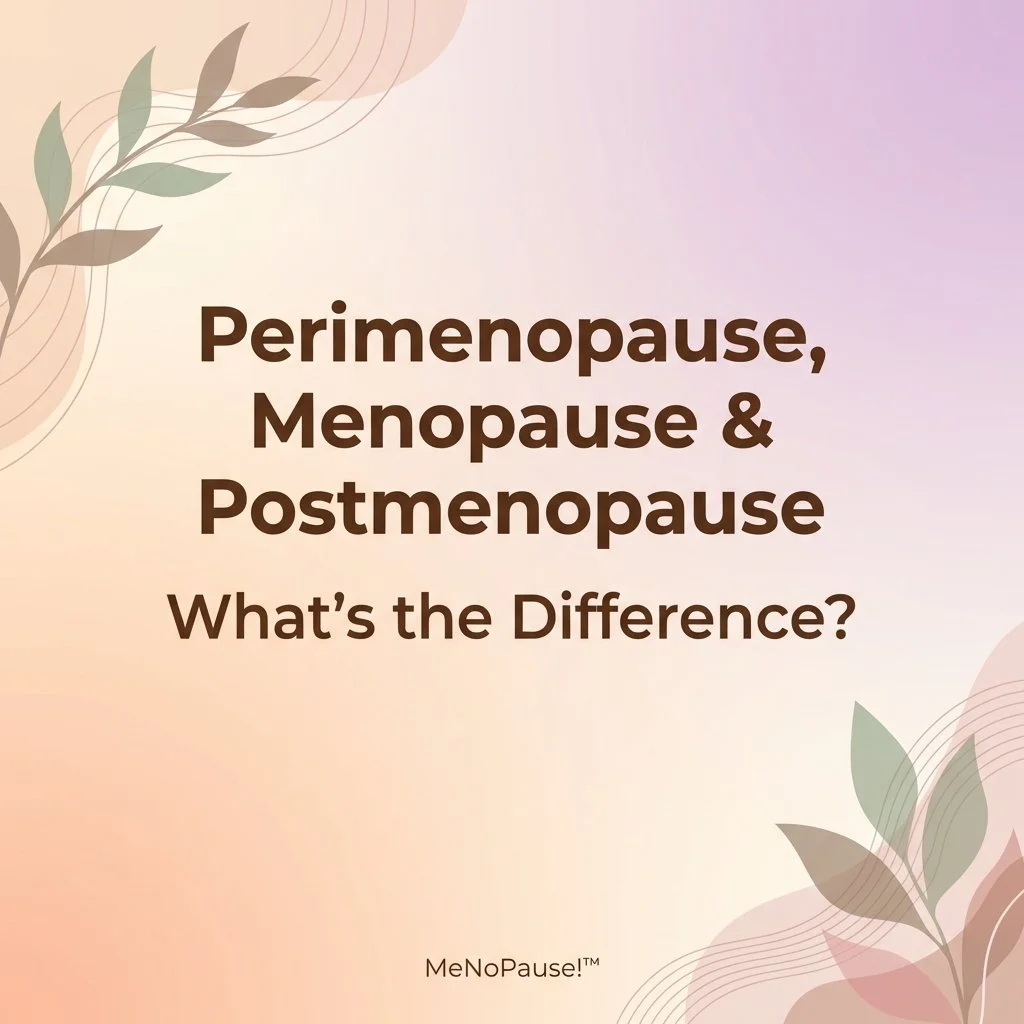
A pastel-colored background with flowers and leaves graphics, featuring the text 'Perimenopause, Menopause & Postmenopause What's the Difference?'
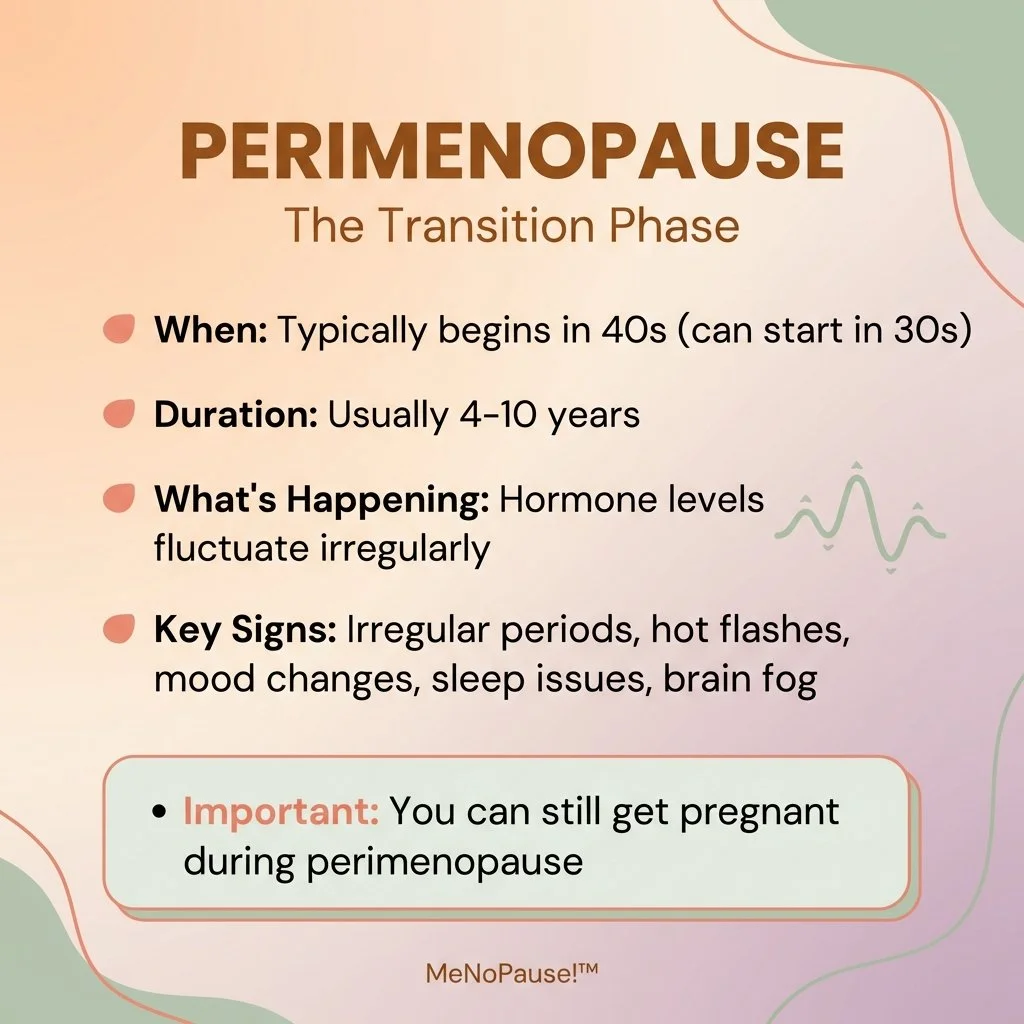
An infographic about perimenopause, the transition phase before menopause, including information on when it begins, its duration, symptoms, key signs, and an important note that pregnancy is still possible during this phase.
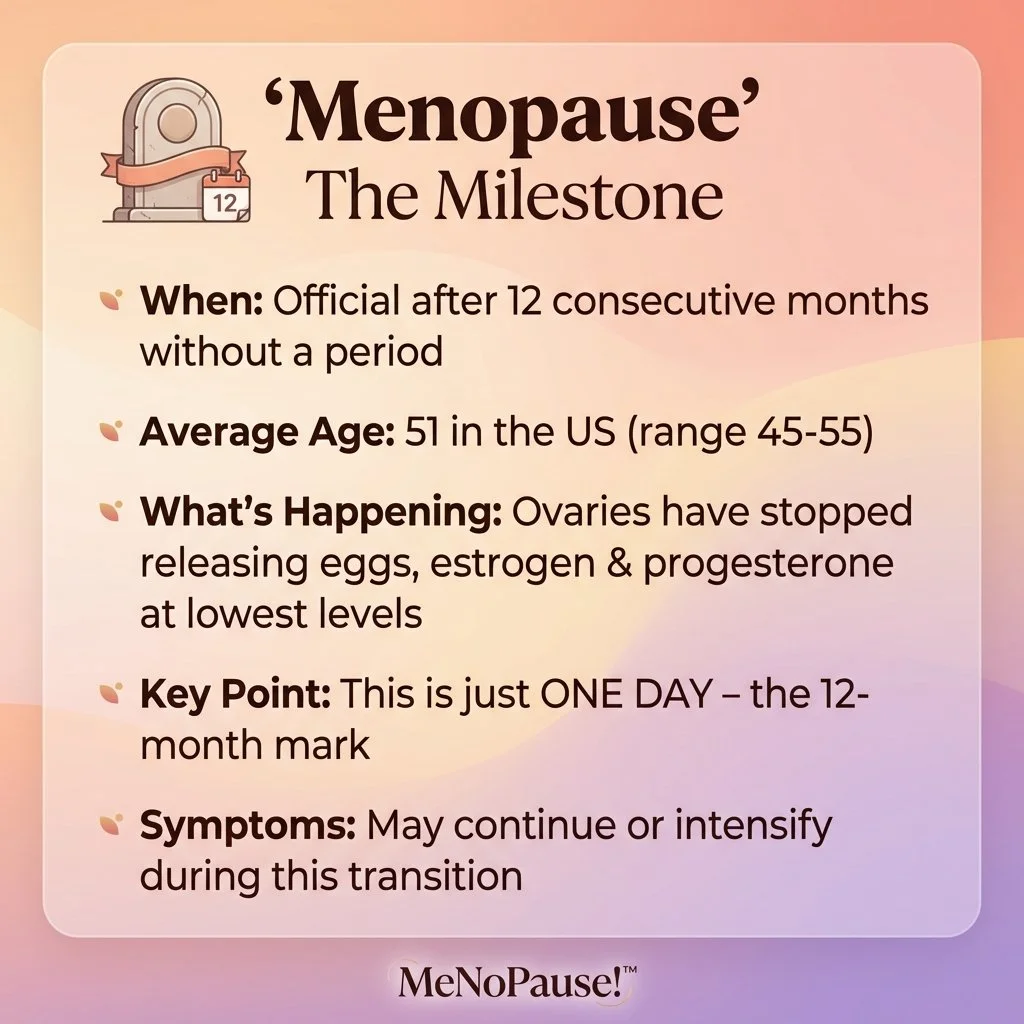
Information graphic about menopause, showing a calendar icon with the 12th marked, and text explaining menopause as the milestone after 12 consecutive months without a period. It states the average age in the U.S. as 51, describes what is happening as ovaries stop releasing eggs and hormones, highlights the 12-month mark as the key point, and notes symptoms may continue or intensify.
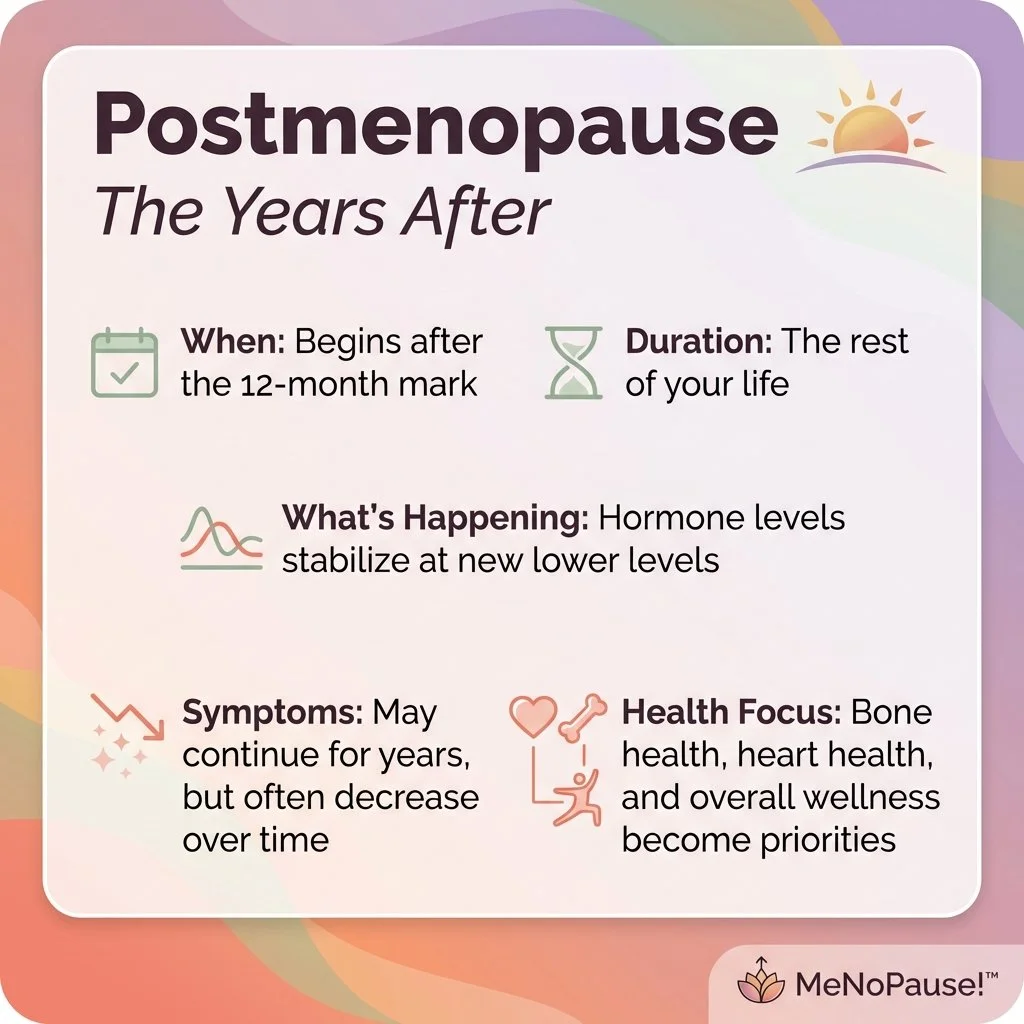
Infographic about postmenopause, with sections on when it begins, duration, what happens hormonally, symptoms, and health focus, from MeNoPause.
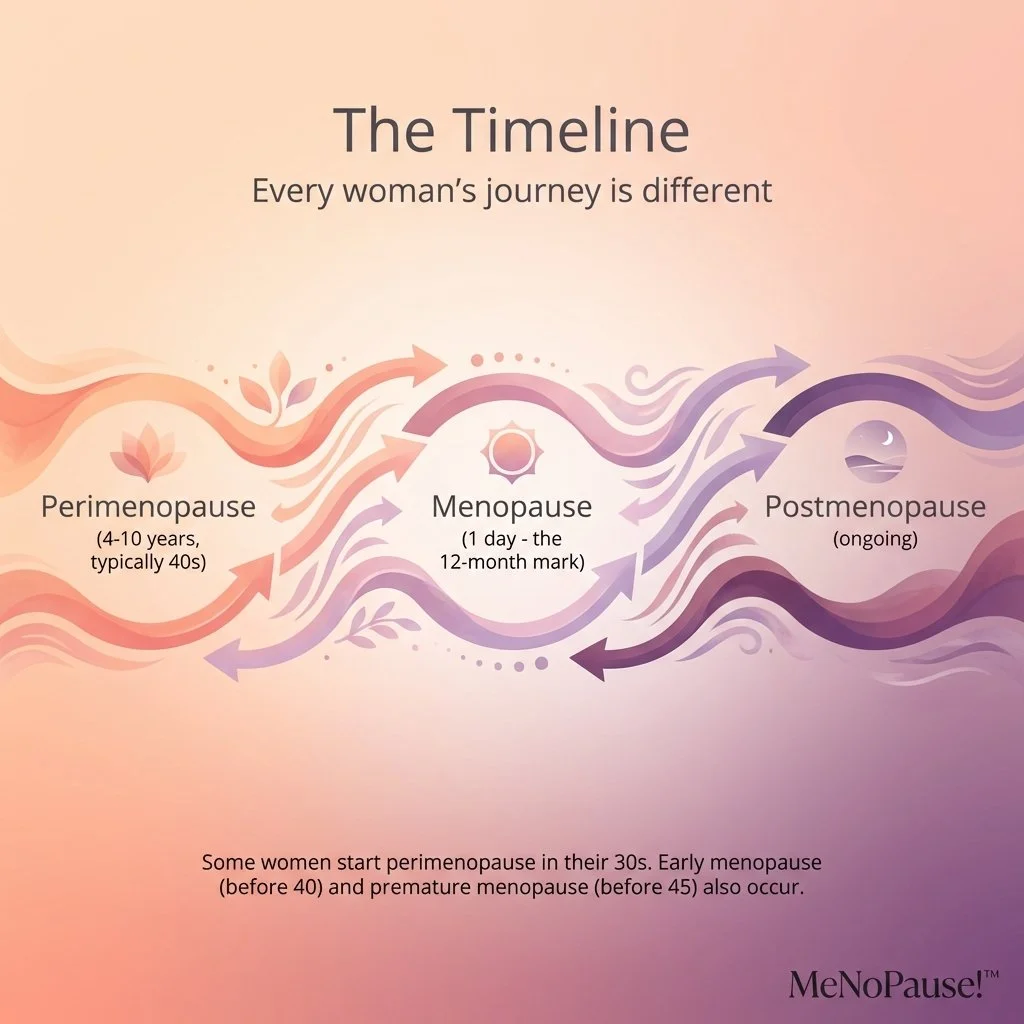
Diagram illustrating the stages of women's hormonal journey: perimenopause, menopause, and postmenopause, with a note about starting perimenopause in her 30s.
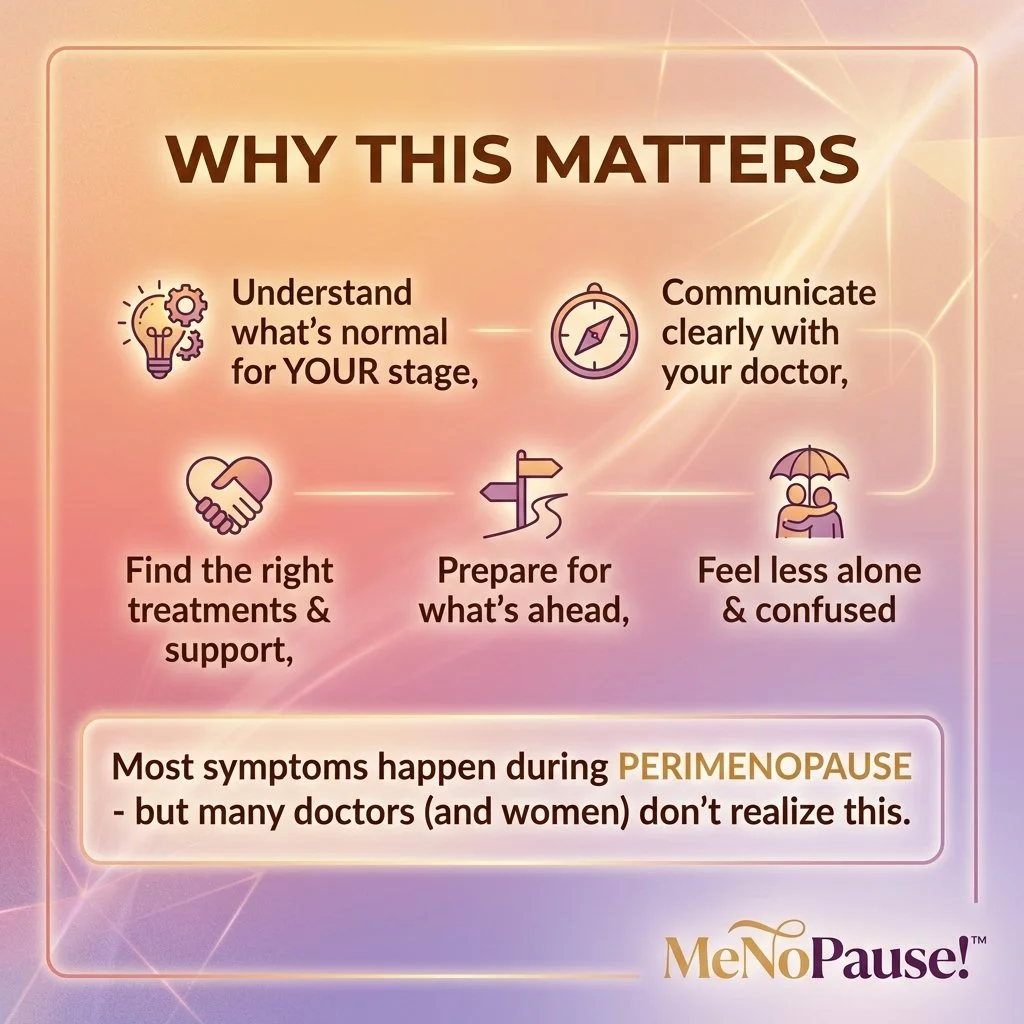
An informational graphic titled 'Why This Matters' explaining the importance of understanding, communicating, and preparing for symptoms related to perimenopause. The graphic includes icons for understanding, communicating with a doctor, support, and feeling less alone, along with a note that most symptoms occur during perimenopause but are often overlooked by doctors and women.

You Might Be in Perimenopause If…

Something feels off - you’re not imagining it, and you’re not alone.
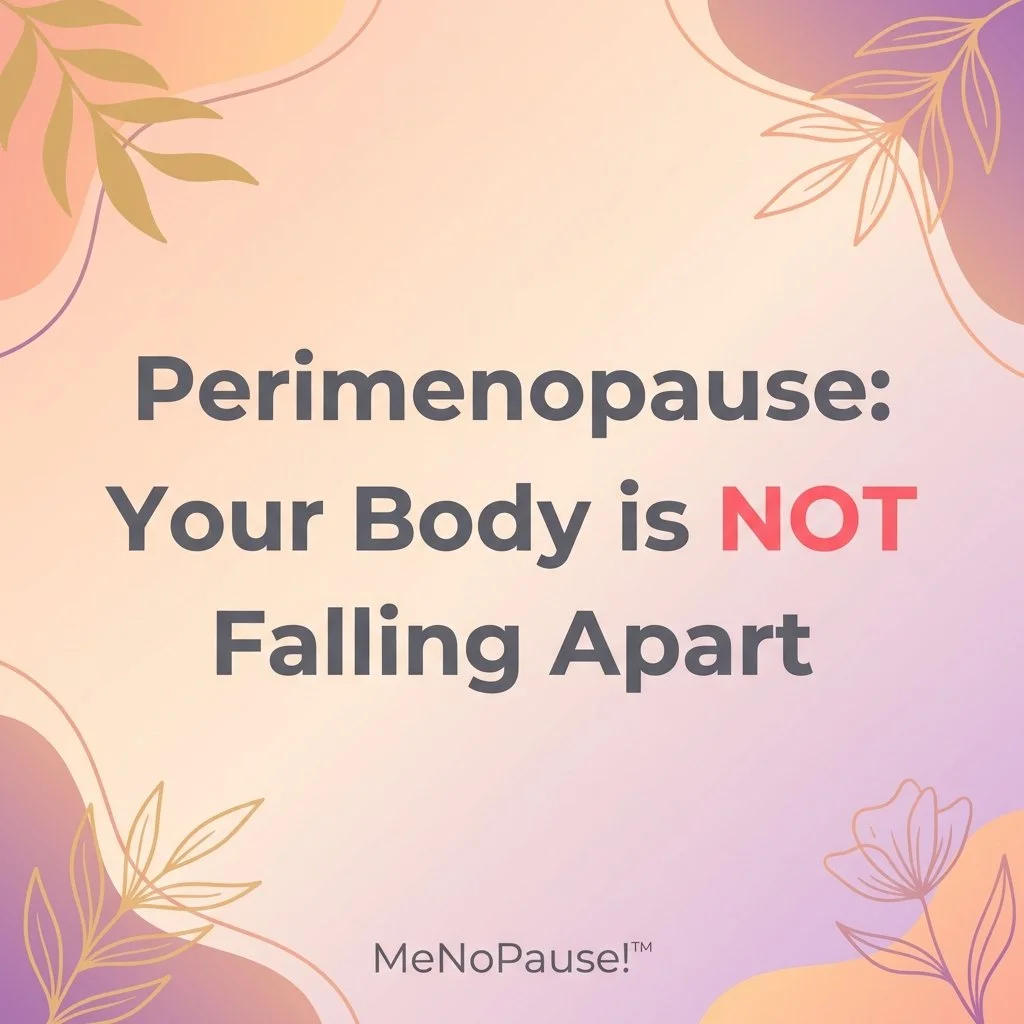
An inspirational quote on menopause and body positivity on a pastel-colored background with floral accents. The quote says, 'Perimenopause: Your Body is NOT Falling Apart,' by MeNoPause.
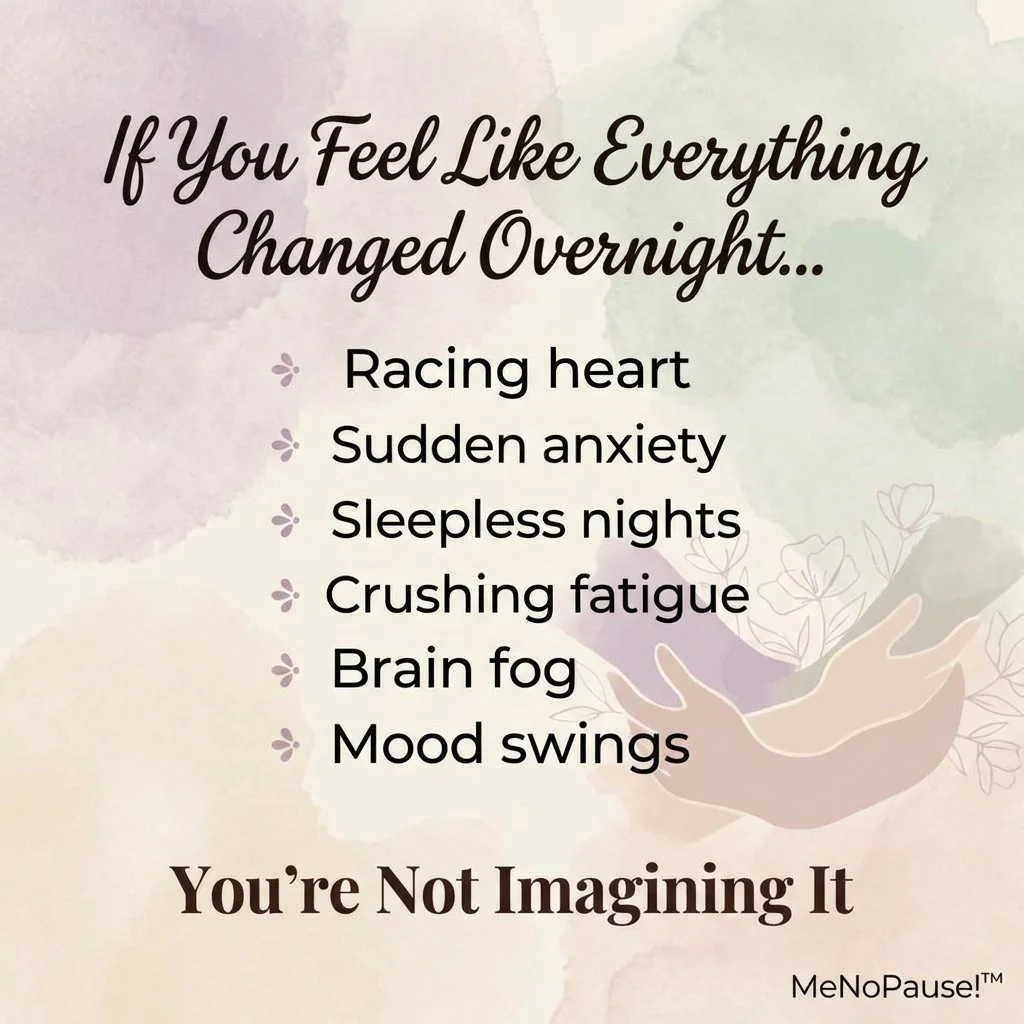
A motivational quote about mental health and emotional struggles, listing symptoms like racing heart, sudden anxiety, sleepless nights, crushing fatigue, brain fog, and mood swings, with the phrase "You're Not Imagining It" at the bottom.
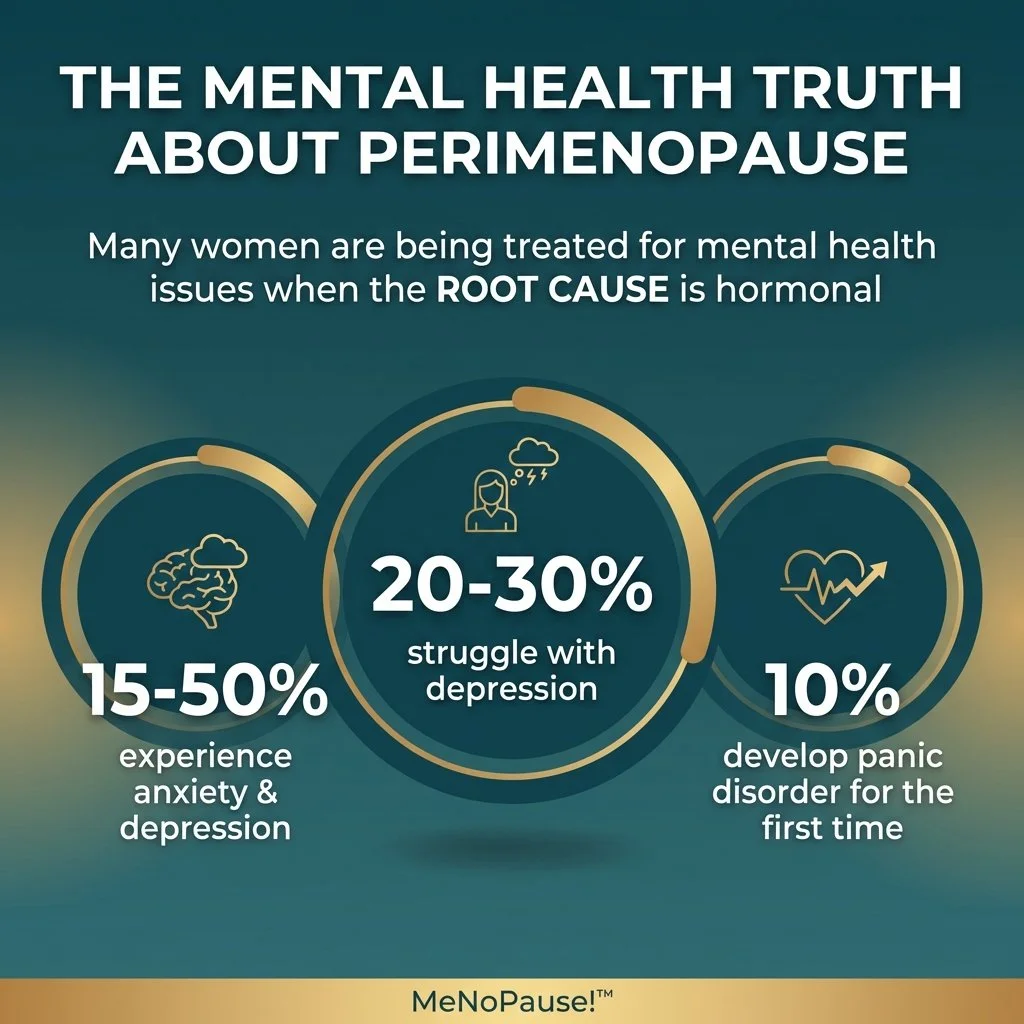
Information graphic titled "The Mental Health Truth About Perimenopause" with statistics showing mental health issues in women related to hormonal changes. It highlights that 15-50% experience anxiety and depression, 20-30% struggle with depression, and 10% develop panic disorder for the first time, linking these to hormonal root causes.
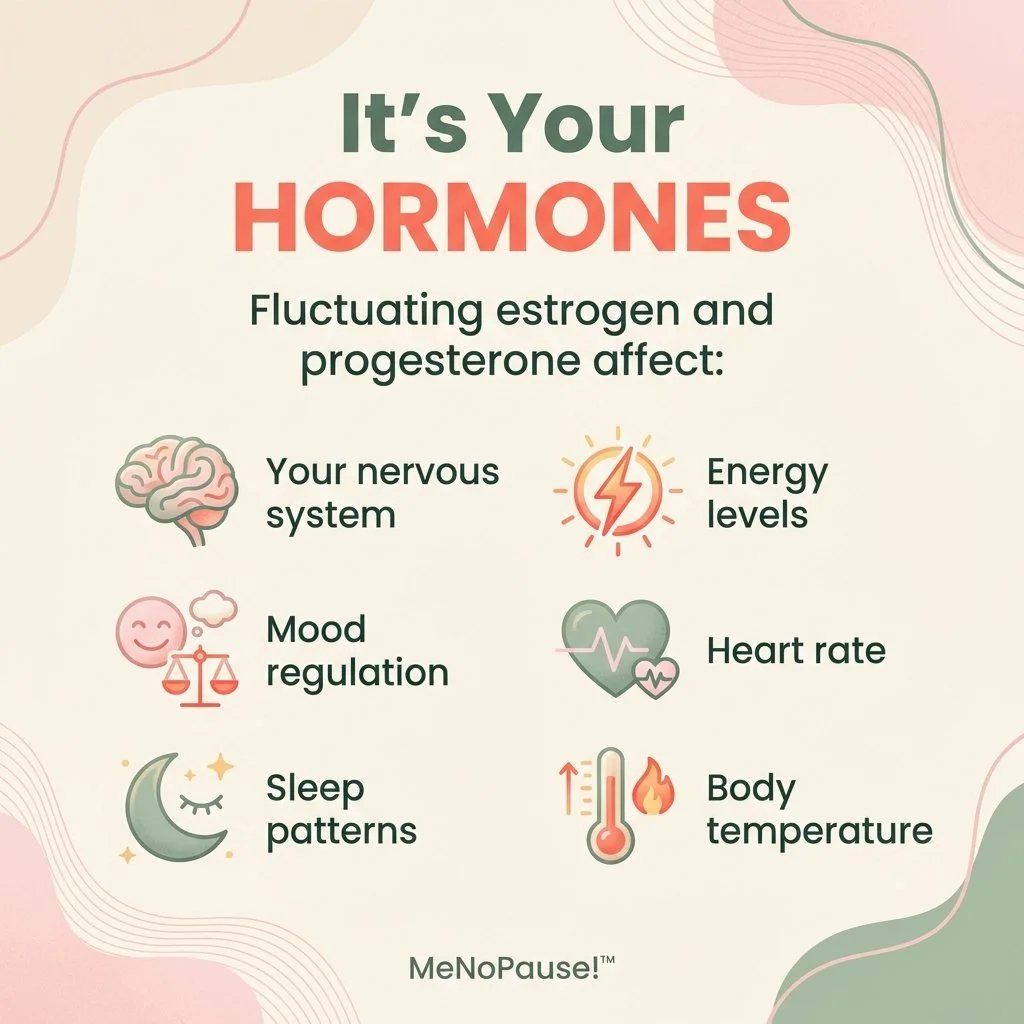
A health infographic titled "It's Your Hormones" explaining how fluctuating estrogen and progesterone affect various aspects of health, including the nervous system, mood regulation, sleep patterns, energy levels, heart rate, body temperature, with icons representing each.
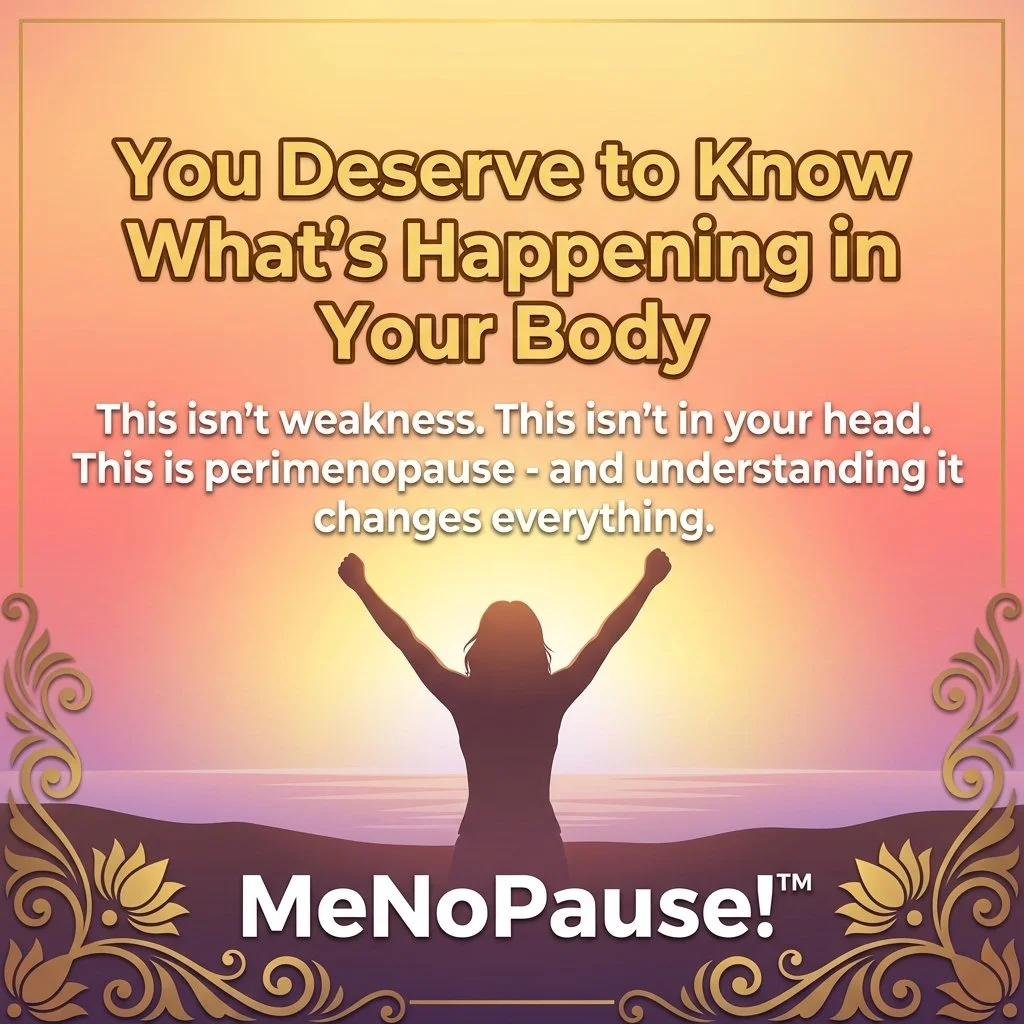
A motivational poster with a silhouette of a woman with arms raised in front of a sunset at the beach, featuring ornate floral designs in the corners and text about understanding your body's changes during perimenopause.

Questions to Ask Your Doctor

You don’t need to have all the answers - but you deserve to ask the right questions.

A pastel-colored background with text about questions to ask your doctor regarding perimenopause and menopause treatment options, decorated with floral illustrations.
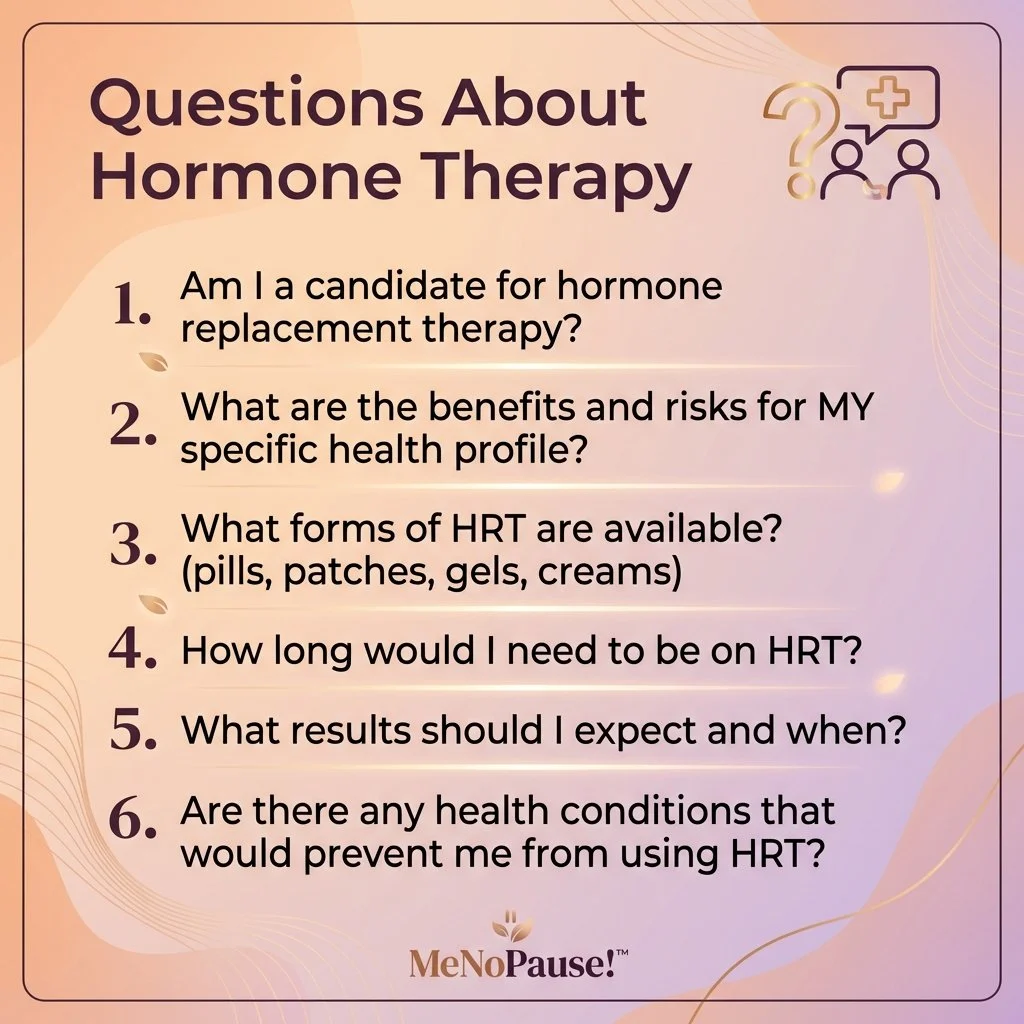
A list titled 'Questions About Hormone Therapy' includes six questions: 1. Am I a candidate for hormone replacement therapy? 2. What are the benefits and risks for MY specific health profile? 3. What forms of HRT are available? 4. How long would I need to be on HRT? 5. What results should I expect and when? 6. Are there any health conditions that would prevent me from using HRT? The background features soft pastel colors with abstract line patterns and icons of question marks and figures.
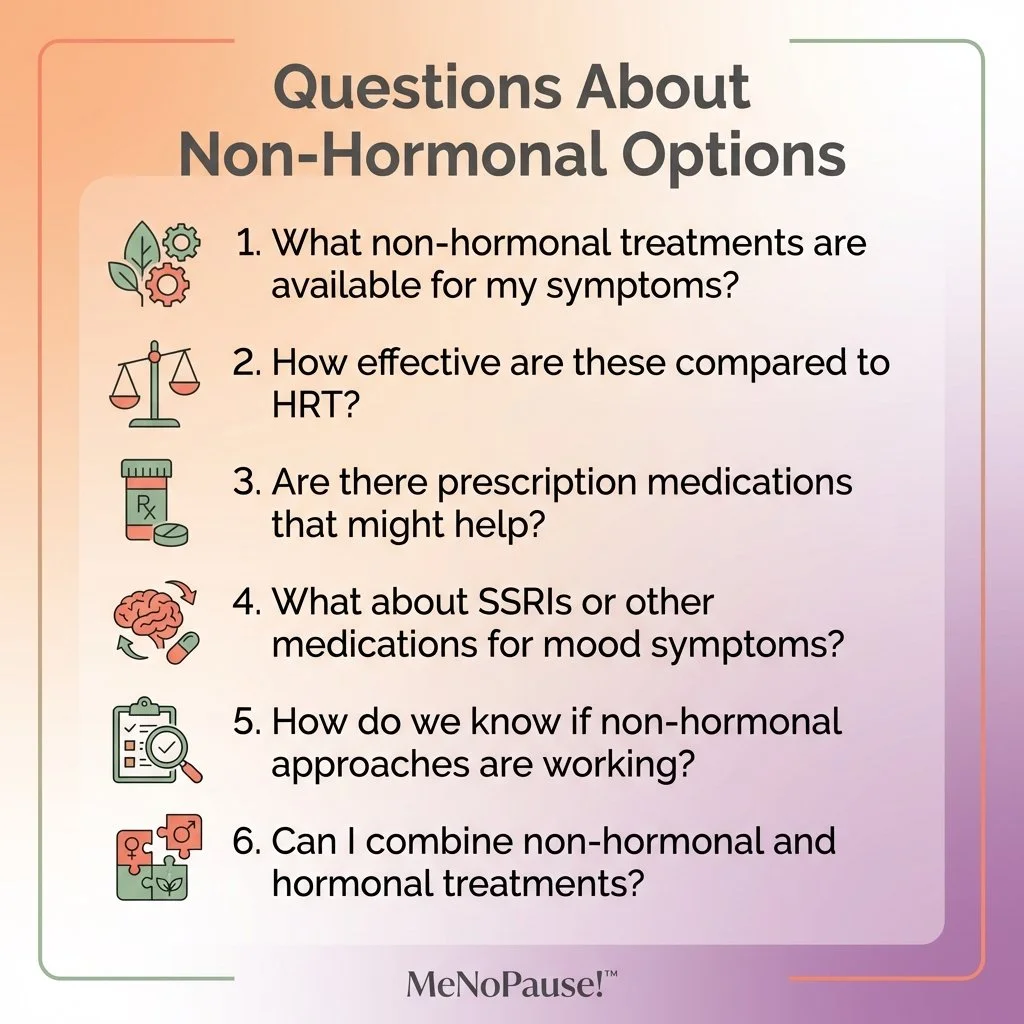
A informational graphic titled "Questions About Non-Hormonal Options" with a list of questions numbered 1 to 6, each with an icon representing different topics such as treatments, effectiveness, medications, mood, and combining treatments. The background has a gradient with soft pastel colors.
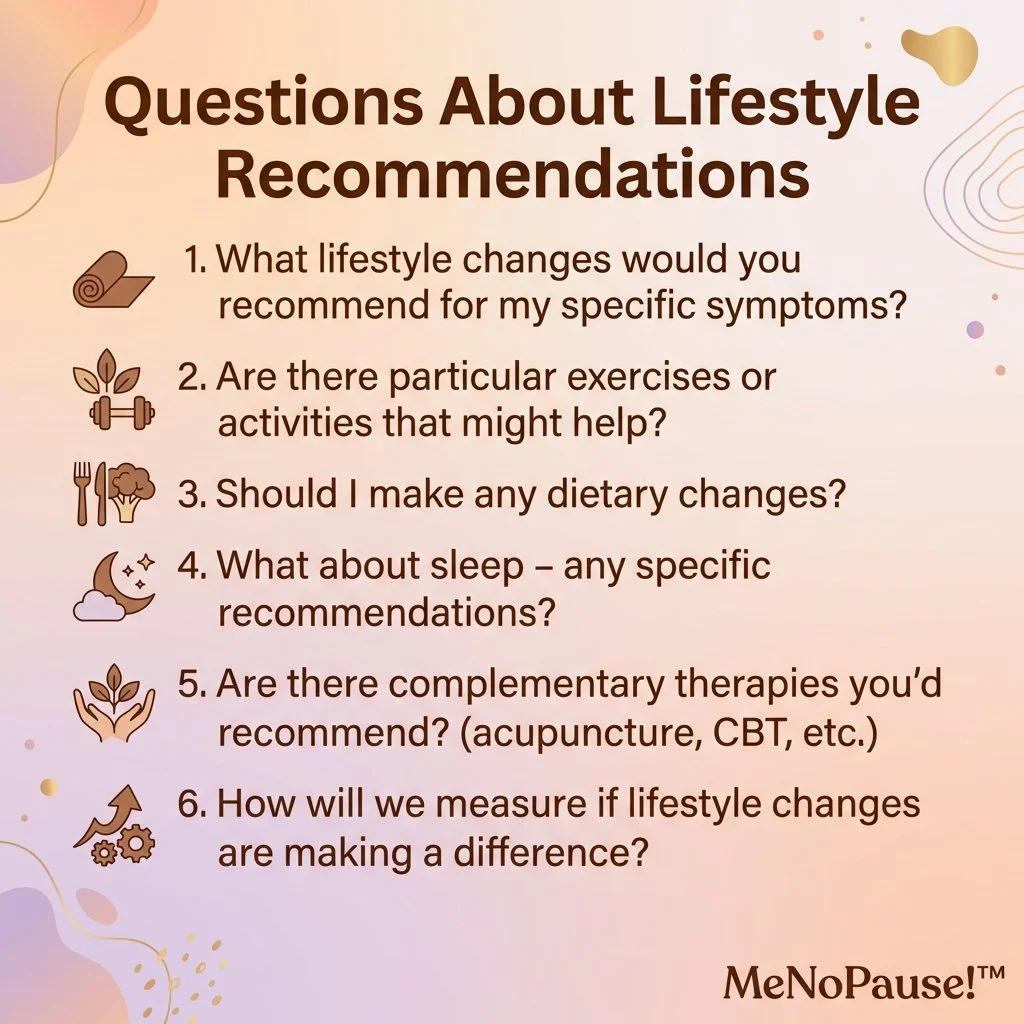
A list of questions about lifestyle recommendations, including topics like lifestyle changes, exercises, diet, sleep, therapies, and measuring progress, with icons for each question on a pastel-colored background.
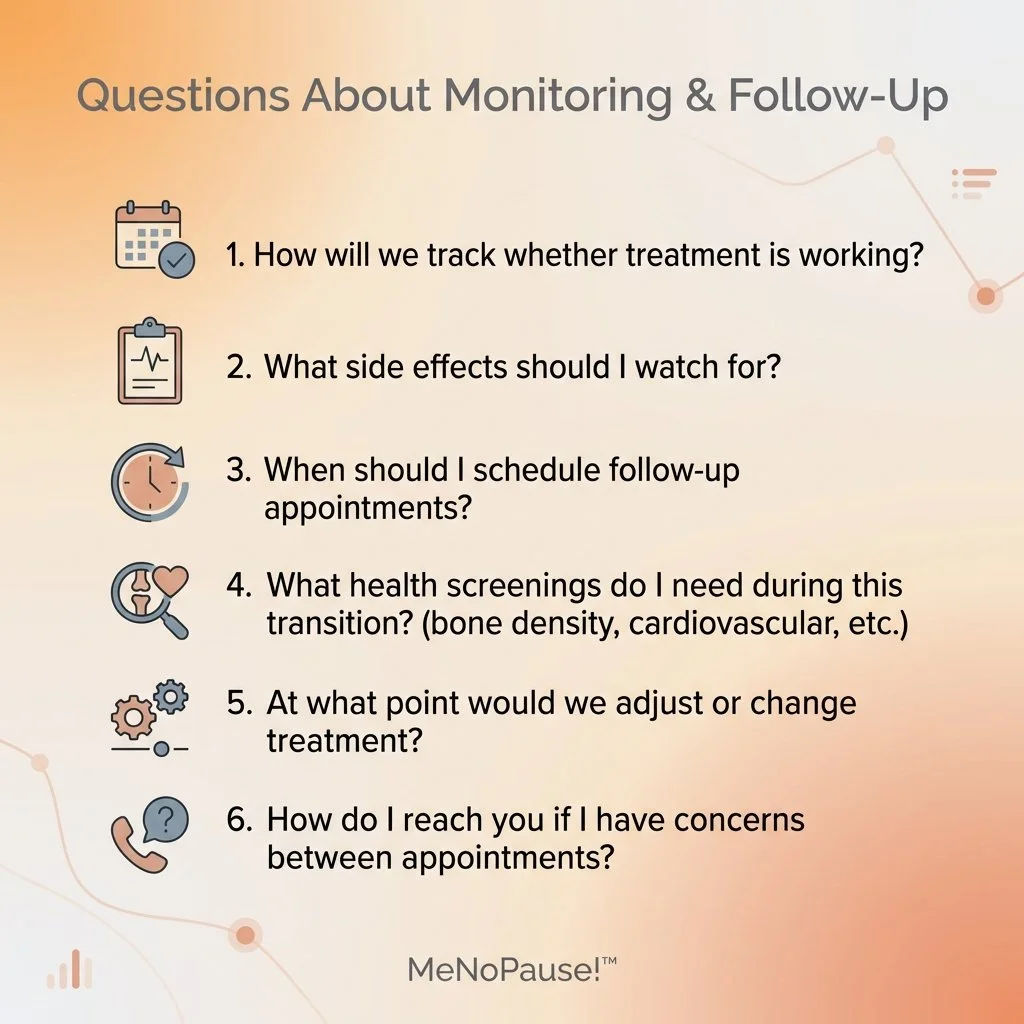
Slide titled 'Questions About Monitoring & Follow-Up' listing six questions about treatment monitoring, side effects, follow-up scheduling, health screenings, treatment adjustments, and communication with healthcare providers, with icons representing each question.
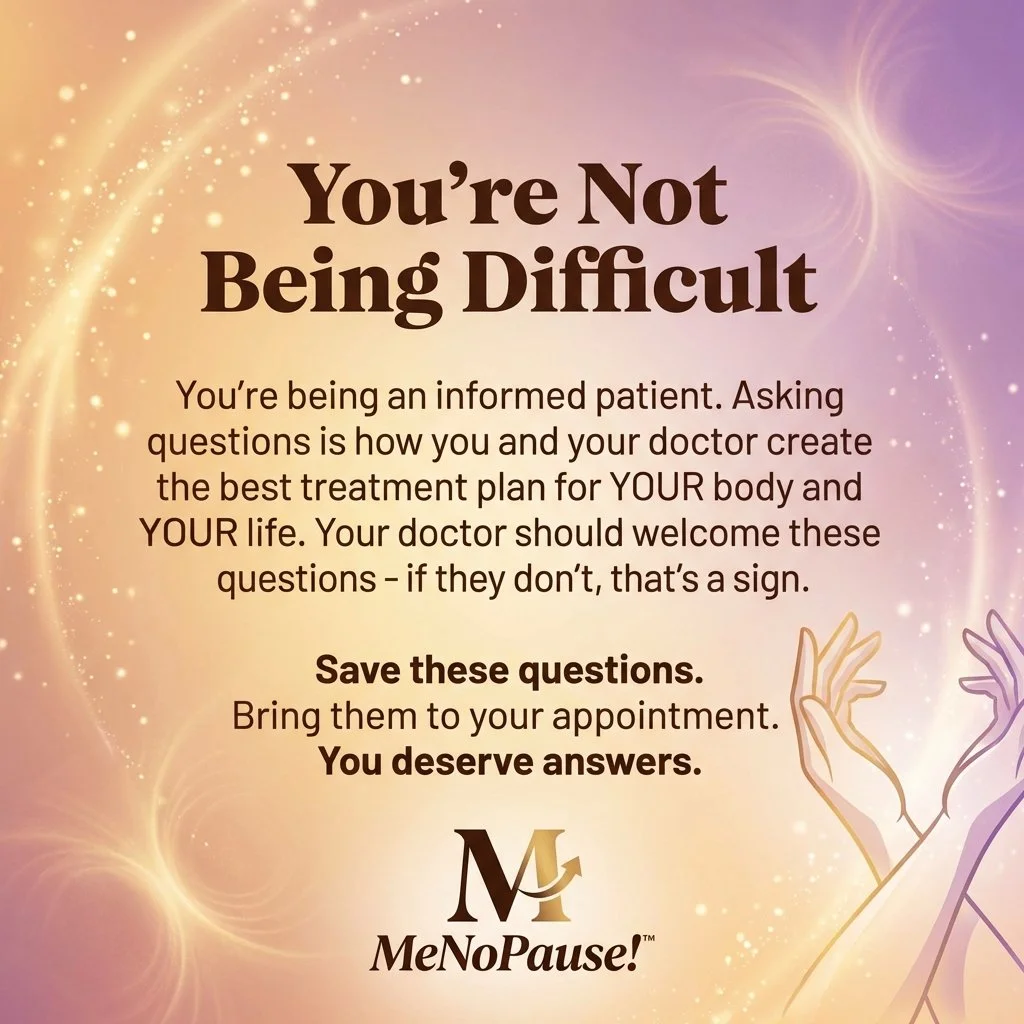
A motivational message encouraging patients to ask questions during medical appointments, with a soft pastel background and illustrations of crossed hands.

How to Talk to Your Doctor

You don’t have to know exactly what to say - just start the conversation.

Guide on how to talk to your doctor about perimenopause with scripts and conversation starters, featuring a pastel background with floral illustrations.
A graphic with a supportive message about health and speaking up, featuring this: a hand holding a smaller hand with a woman with arms raised above her head emerging from the smaller hand, all set against a pastel gradient background with a lotus motif.
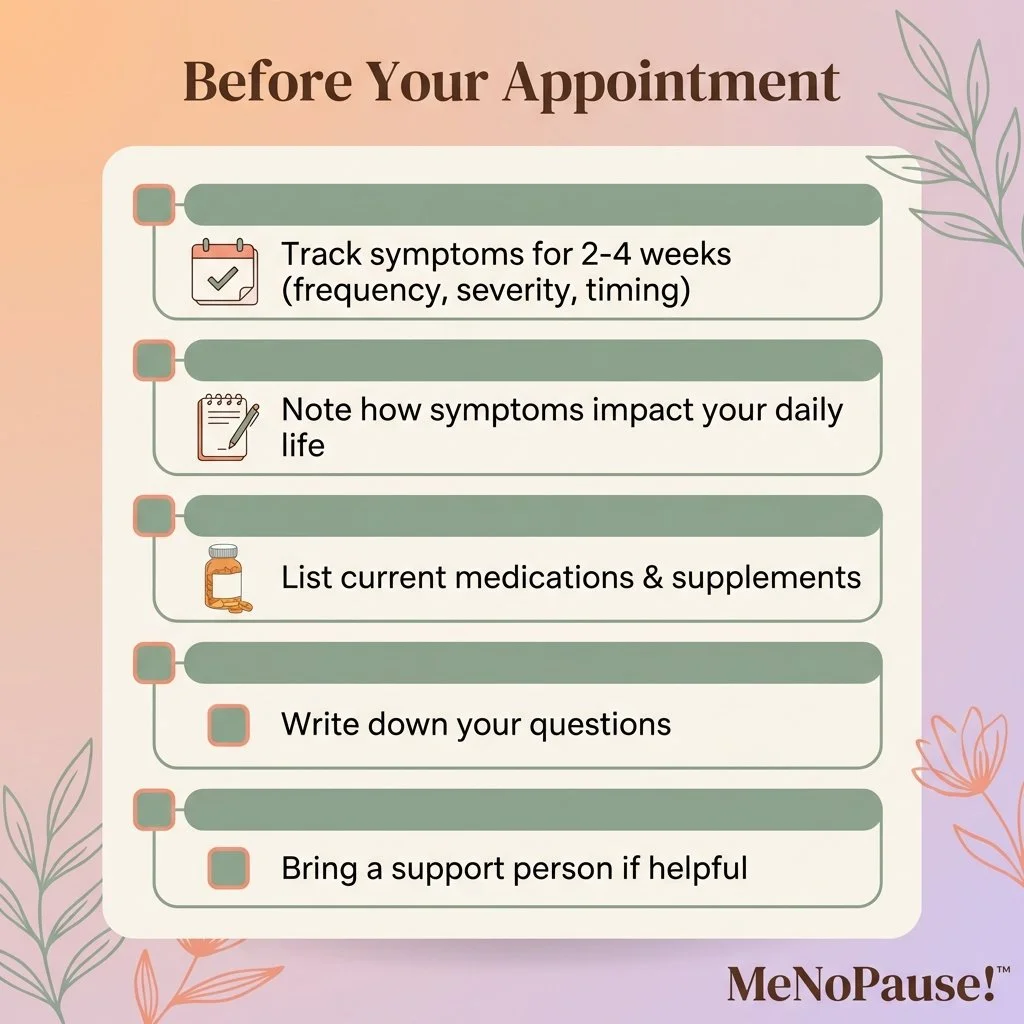
Checklist titled 'Before Your Appointment' with five steps: 1. Track symptoms for 2-4 weeks. 2. Note how symptoms impact daily life. 3. List current medications and supplements. 4. Write down your questions. 5. Bring a support person if helpful. Background features pastel colors and floral accents.
A motivational graphic with a pastel gradient background, featuring two text boxes. The first box reads 'I've been experiencing symptoms that I believe may be related to perimenopause. I'd like to discuss treatment options.' The second, alternative opening reads 'My quality of life is being affected by [specific symptoms]. Can we explore whether this could be perimenopause?' A small speaker icon suggests being direct and confident, and the logo 'MeNoPause' appears at the bottom.
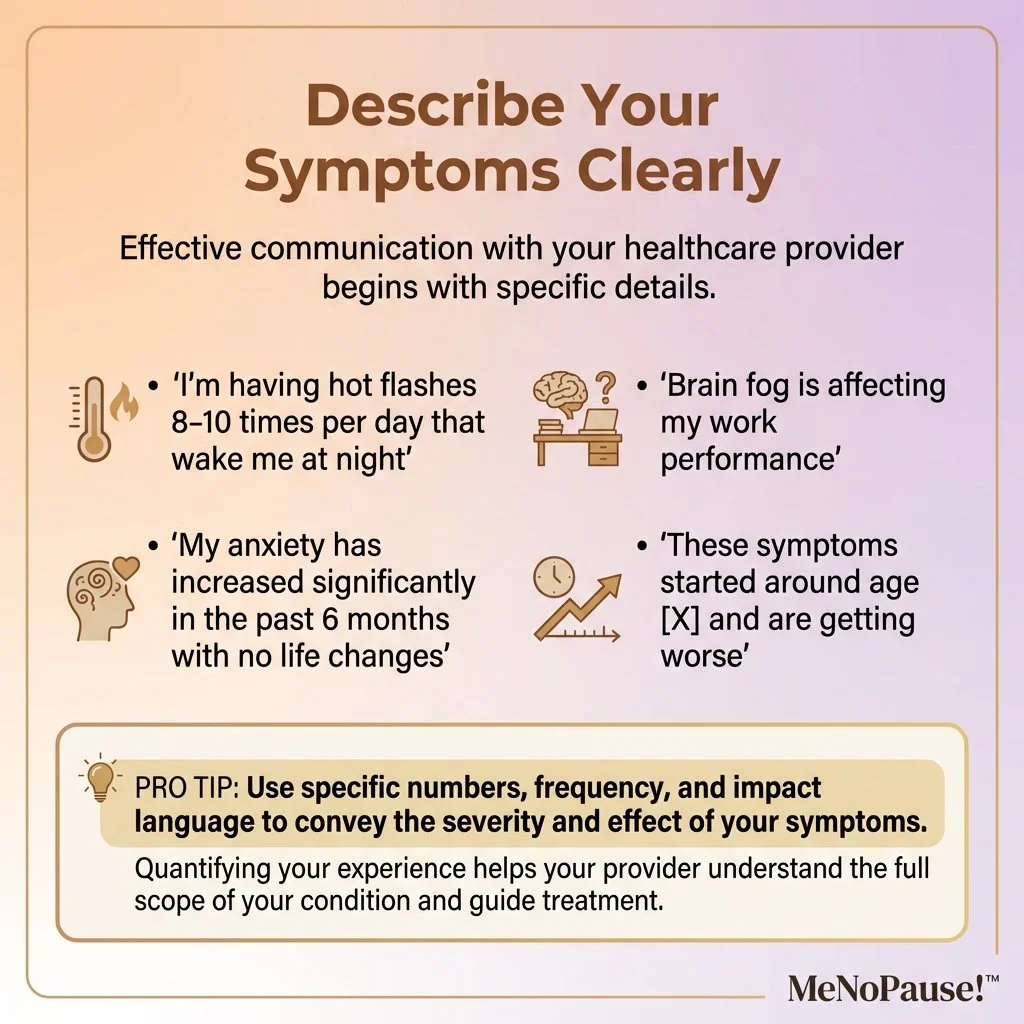
A guide titled 'Describe Your Symptoms Clearly' with tips on effective communication with healthcare providers. It includes examples like hot flashes, anxiety, brain fog, and age-related symptoms, and emphasizes using specific numbers and impact language.
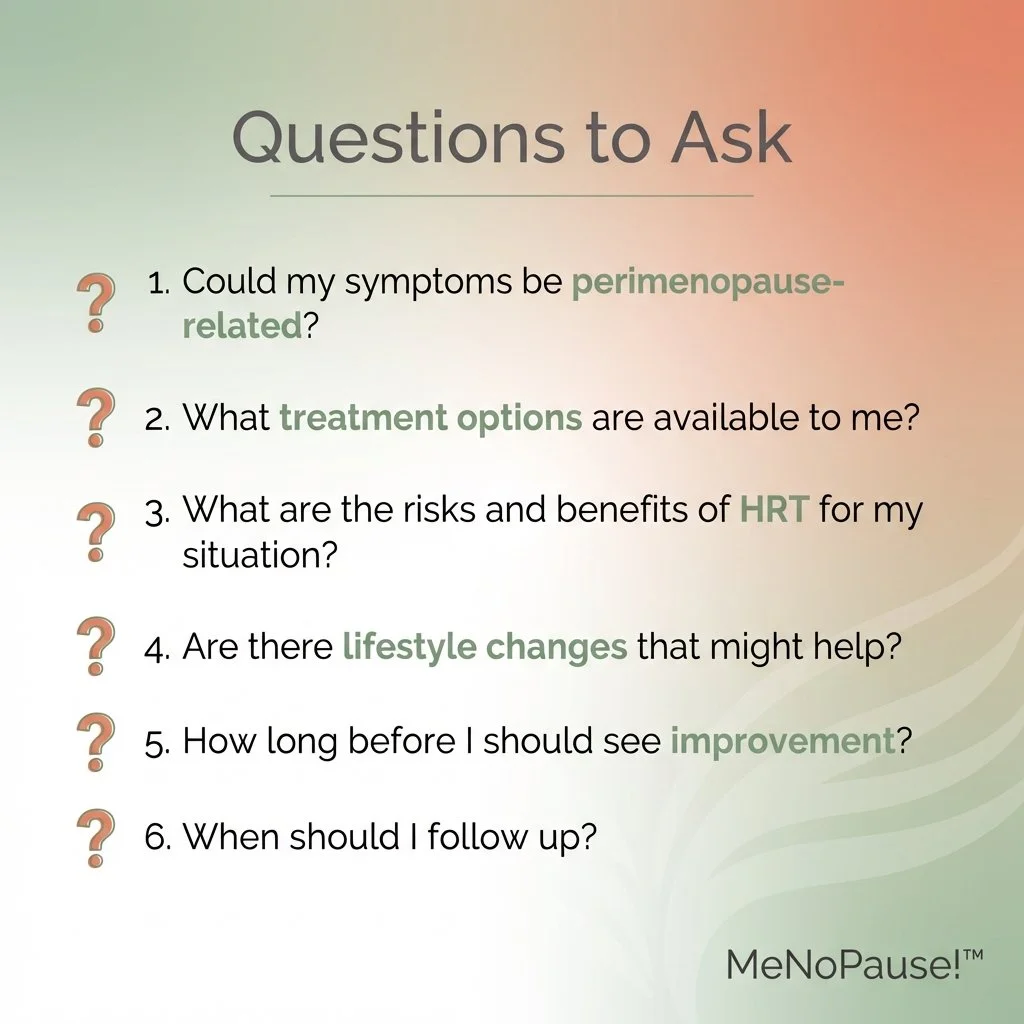
A slide titled 'Questions to Ask' with six questions related to menopause and treatment options. The background has pastel shades of green and peach, and the text includes questions about symptoms, treatment options, risks and benefits of HRT, lifestyle changes, improvement timeline, and follow-up.
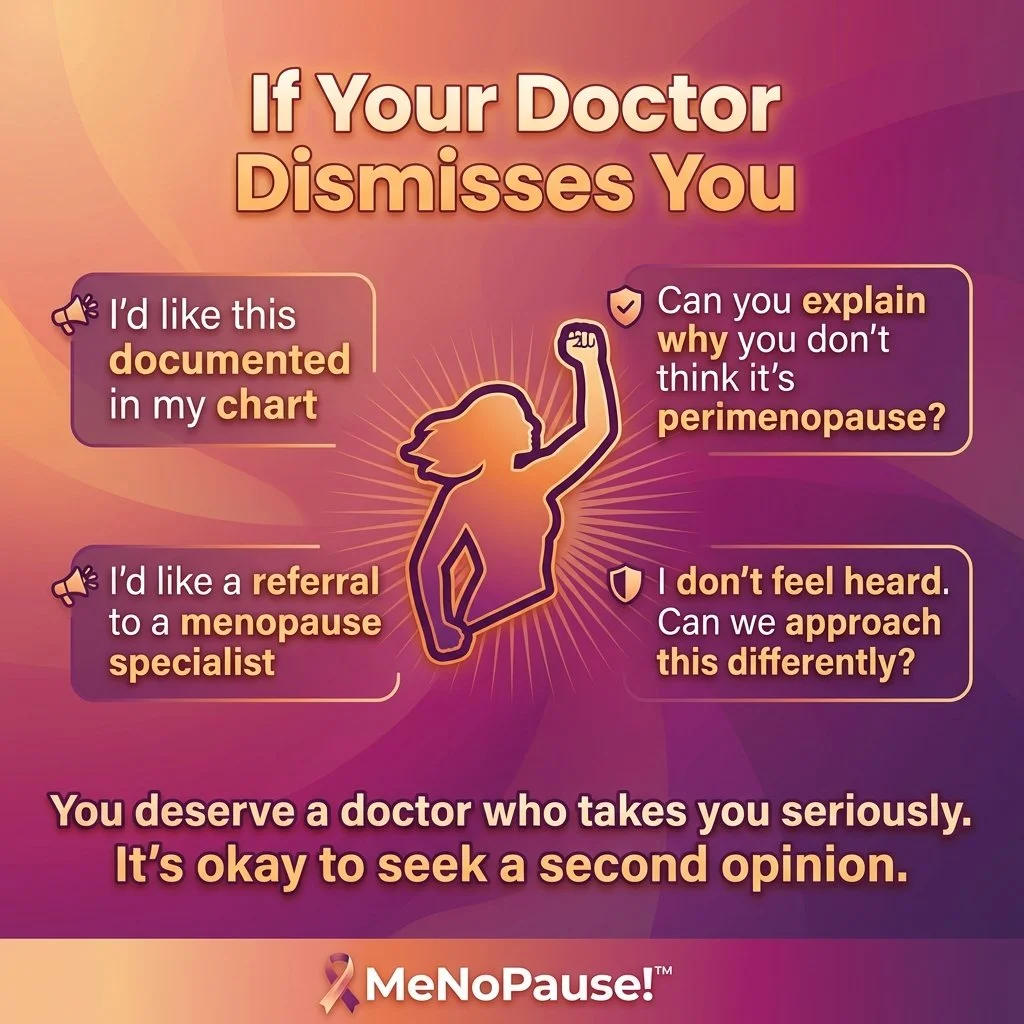
A graphic with a pink and purple background and a silhouette of a woman with a raised fist in the center. The graphic features support messages about menopause, including: "I'd like this documented in my chart," "I'd like a referral to a menopause specialist," "Can you explain why you don't think it's perimenopause?" and "I don't feel heard. Can we approach this differently?" A message at the bottom states: "You deserve a doctor who takes you seriously. It's okay to seek a second opinion." The logo "MeNoPause!" appears at the bottom.